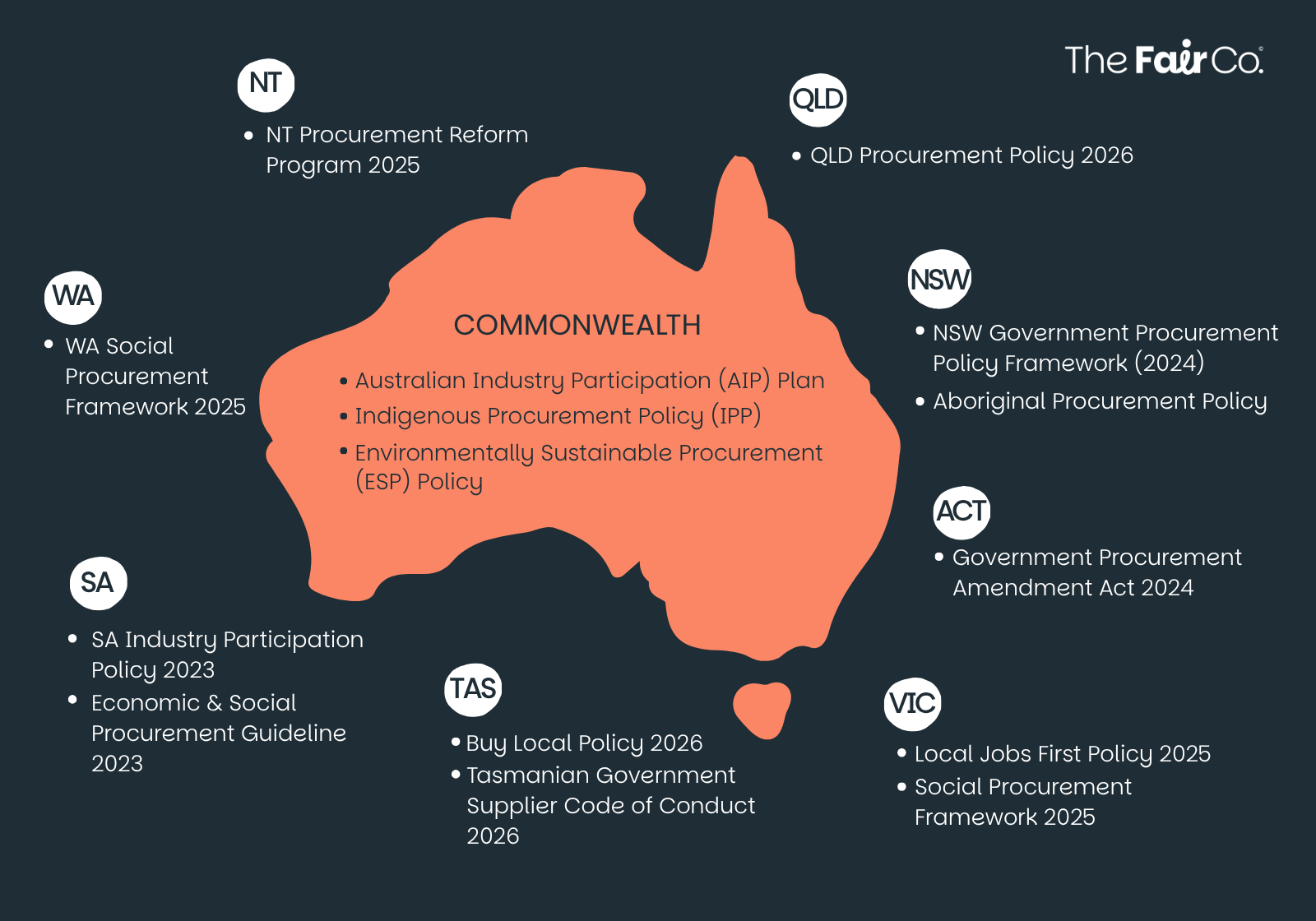
We’re kicking off a new blog series on Australia’s social procurement landscape. Starting with Commonwealth policy, then unpacking key state and territory policies next.
Across Australia, social procurement is shaped by a mix of state and territory frameworks alongside national Commonwealth policies. While the specifics vary, the intent is consistent. Procurement is increasingly being used to drive economic participation, social outcomes and environmental impact.
This blog series builds on the Deakin University, School of Architecture and Built Environment, Australia paper titled Building a Better Future: The Australian Journey Towards Achieving Sustainable Development Through Social Procurement Policies (Kathriarachchige Dona et al. 2025), which collectively researched how social procurement policies across Australia are helping to progress outcomes related to the UN’s Sustainable Development Goals (SDGs).
From research to date, and industry experience supporting the delivery of social procurement outcomes, The Fair Co. has summarised the key social license and social impact policies across Australia that deliver social procurement outcomes.
At the Commonwealth level, three key policies are leading this shift: together, they are reshaping how major projects are planned, delivered and measured.
Australian Industry Participation (AIP) Policy
The AIP policy gives Australian businesses, especially SMEs, the chance to bid on major projects and Commonwealth-funded activities. It sits under the AIP National Framework, with the AIP Authority in the Department of Industry, Science and Resources approving all plans. The policy splits into two streams.
The Commonwealth AIP (CAIP) stream applies to government procurements, grants and investments of $20 million or more. Successful suppliers are required to develop a plan outlining how they will engage Australian SMEs, and then report on how those commitments are delivered throughout the project.
The Australian Jobs Act 2013 stream applies to major public or private projects with capital expenditure of $500 million or more to establish or upgrade a productive facility, whether or not the project receives Commonwealth funding. Proponents prepare an AIP plan, publicly advertise procurements of $1 million or more, and report through Compliance Reports.
Where multiple frameworks apply, a single plan can often meet multiple requirements, helping reduce duplication across Commonwealth and state obligations.
Indigenous Procurement Policy (IPP)
The IPP has been a central part of the Commonwealth’s approach to economic inclusion since 2015 and has significantly increased opportunities for First Nations businesses.
The policy operates through a combination of procurement targets, mandatory set-asides, participation requirements and exemptions that allow direct purchasing from Indigenous SMEs. These mechanisms are designed to ensure both the number and value of contracts awarded to Indigenous businesses continue to grow. The Mandatory Minimum Indigenous Participation Requirements (MMR) apply to Commonwealth contracts wholly delivered in Australia valued at $7.5 million or more in 19 industries. They set targets for Indigenous employment, business participation, or both.
From 1 July 2026, two changes take effect. First, the number and value targets each step up by 0.25% to 3.25%, the first of four annual increases that reach 4% by 2029-30. Second, the ownership and control test rises from 50% to 51% Indigenous ownership and control. Businesses registered with the Office of the Registrar of Indigenous Corporations (ORIC) under the CATSI Act will continue to qualify through that pathway.
The shift from 50% to 51% is designed to move majority decision-making genuinely into Indigenous hands and disrupt the ‘black cladding’ arrangements that have weakened the policy in practice. Detailed transitional arrangements are still to be released by NIAA.
Environmentally Sustainable Procurement (ESP) Policy
The ESP Policy reflects the growing importance of sustainability in procurement decisions. Introduced in 2024, it is being rolled out across high-impact categories.
Construction services valued at $7.5 million or more were the first to fall within scope. From 2025, the policy expanded to include product categories such as ICT goods, furniture, and textiles valued at $1 million or more.
A key requirement is the Supplier Environmental Sustainability Plan, which suppliers must submit as part of the tender process. This sets out how environmental outcomes will be delivered, including emissions reduction, resource efficiency and circularity, and how those outcomes will be measured over time.
What this means in practice
For organisations involved in major projects, this means navigating a more connected landscape where Commonwealth and state requirements often overlap. It also means moving beyond compliance. Success depends on early planning, a clear strategy and a practical approach to delivering outcomes.
At The Fair Co., we support clients to navigate this evolving space, helping translate policy into practical action and ensuring projects deliver meaningful social, economic and environmental impact.
Up next, we’re diving into Victoria’s policies and the latest updates. Stay tuned!